Thursday, March 7, 2013

Heart Beet Salad


Heart Beet Salad
2 large beets
6 oz fresh goat cheese
1 blood orange, segmented
1 teaspoon cara cara orange zest
1 cara cara orange, segmented
2 tablespoons fresh orange juice
1 tablespoon red wine vinegar
2 tablespoons extra virgin olive oil
2 handfuls arugula
1/4 cup toasted hazelnuts, roughly chopped
Salt and pepper to taste

Preheat oven to 400 F. Rinse the beets and trim off the greens (you can save them to sauté later if you want). Wrap in foil and roast until tender, about 1 hour. When they’re done you should be able to easily pierce the beets through with a knife. Remove from the oven, unwrap from foil, and let cool. When the beets are cool enough to handle, peel the skin off. Slice the beets into 1/4-inch slices. You should have at least 4 slices of beets per person. Cut out a heart shape from the beet slices using the cookie cutter. Pat the slices dry. Make the napoleon stacks by layering the beet heart slices and goat cheese until you have two beautiful stacks. Try to spread the goat cheese evenly. Clean up edges with a paper towel. (Do not assemble this too far ahead of time because if your beets are juicy, they will color the goat cheese pink as they sit.) Zest the cara cara oranges and set aside a teaspoon for the dressing. Segment both oranges. After segments are cut, squeeze the juice out of the leftover pulp. Reserve for dressing. Make dressing by whisking together orange juice, zest, red wine vinegar, olive oil, and salt and pepper to taste. Dress the arugula and orange segments. Arrange around the beet heart napoleon. Scatter hazelnuts around.
Special Equipment: heart-shaped cookie cutter; be sure that your cookie cutter fits within the circumference of your beets

Source

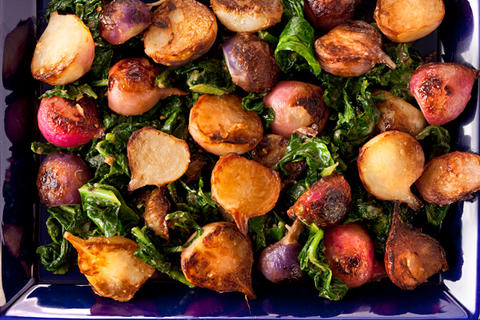
Pan-seared Radishes with Miso Butter


Pan-seared Radishes with Miso Butter

2 tablespoons unsalted butter, at room temperature
2 tablespoons red miso paste, at room temperature
1/4 teaspoon togarashi powder
3 bunches medium radishes with their tops
2 tablespoons vegetable oil
Kosher salt
2 tablespoons water
1/4 teaspoon rice vinegar

Place the butter, miso, and togarashi in a small bowl and mash with the back of a spoon until evenly combined; set aside.
Cut the leafy tops from the radishes. Coarsely chop, wash, and dry the tops; set them aside. Wash the radishes, trim the stem ends, and halve them (quarter them if they’re large) and set aside.
Heat the oil in a large frying pan over medium-high heat until shimmering. Add the radishes and arrange them cut-side down in a single layer. Season with salt and sear until golden brown, about 4 to 5 minutes. Flip and cook the other side until golden brown and the radishes are crisp-tender, about 3 to 5 minutes more.
Reduce the heat to medium. Add the radish tops, 1 tablespoon of the water, and salt to taste. Cook, tossing occasionally with tongs, until the tops are completely wilted, about 2 minutes.
Remove the pan from the heat. Add the butter-miso mixture and the remaining tablespoon of water and stir until the butter-miso mixture melts and coats the radishes and radish tops. Add the vinegar and stir to combine. Taste and season with salt as needed.

Source

Stir-fried Bok Choy with Mizuna and Tofu


Stir-fried Bok Choy with Mizuna and Tofu

3 1/2 tablespoons soy sauce, divided
4 teaspoons Asian sesame oil, divided
3 1/2 teaspoons unseasoned rice vinegar, divided
1 14- to 16-ounce container extra-firm tofu, drained
2 tablespoons peanut oil
4 green onions, chopped
1 tablespoon finely chopped peeled fresh ginger
2 garlic cloves, finely chopped
4 baby bok choy, leaves separated
A head of loosely packed mizuna (about 8 ounces)

Whisk 2 tablespoons soy sauce, 2 teaspoons sesame oil, and 1/2 teaspoon vinegar in bowl. Stack 2 paper towels on work surface. Cut tofu crosswise into 3/4-inch-thick slices; cut each slice crosswise in half. Arrange tofu on paper towels and let stand 10 minutes. Pat top of tofu dry. Heat peanut oil in large nonstick skillet over medium-high heat. Add tofu and cook, without moving, until golden brown on bottom, 2 to 3 minutes per side. Transfer tofu to paper towel to drain, then place tofu on sheet of foil and brush both sides with soy sauce mixture. Wipe out any peanut oil from skillet. Add 2 teaspoons sesame oil and place skillet over medium heat. Add green onions, ginger, and garlic. Stir until fragrant, about 30 seconds. Add remaining 11/2 tablespoons soy sauce and 3 teaspoons vinegar, then bok choy. Toss until bok choy wilts, 1 to 2 minutes. Add mizuna in 2 batches, tossing to wilt before adding more, 1 to 2 minutes per batch. Season greens with salt and pepper. Add tofu to skillet. Toss gently to blend. Transfer to platter.

Source


Tuesday, October 23, 2012

What the Heck is Purslane and What Can I Do With It?


Purslane is a weed or it’s an herb or a leafy green, I guess it depends on who you are and if you have to pull it from your garden. Purslane has been touted as having very high Omega-3 fatty acids, higher than some fish oils even. Every vegetarian and vegan in your life should take note of this. Purslane is used mostly in Greek and Asian cuisine.  According to Wild Man Steve Brill, purslane was Ghandi's favorite food. It can be eaten raw or in stews, soups and other cooked dishes. 

Since this weeks basket also includes cucumbers and tomatoes, I thought perhaps this recipe from simplyrecipes.com might be a lovely one to post. 

Tomato, Cucumber, Purslane Salad


1 large cucumber, peeled, seeded, quartered lengthwise, and chopped
1 medium tomato, chopped
1 bunch or purslane, thick stems removed, leaves chopped (results about 1/2 cup)
1 minced, seeded jalapeño
2-3 Tbsp of fresh lemon juice
Salt to taste

Combine all ingredients and serve. 

I also found a very simple recipe on adventuressheart.com. 


Eggs and Purslane


Sauté purslane leaves and skinnier stems with garlic and butter or oil and scramble some eggs into your sautéed purslane. Voila! 

I am sure with a bit of research, you can all add some delicious recipes to this. If you have a favorite purslane recipe, please leave it in the comments. 

Sunday, February 26, 2012

(Whole) Roasted Cauliflower

The inspiration for this recipe came from an Eating Well recipe for the cauliflower, but prepared in the microwave. It would probably turn out fine that way but I know for a fact that the cauliflower we recently got from the CSA wouldn't have fit in my microwave(!) and for that reason (its outrageous size), I thought this recipe might just work fine in the oven. I was right, it was yummy and I suspect even better than the microwave version, although it took quite a bit longer to cook. The nice thing with either approach is that you can use just about any flavor profile you desire, and once you get the mixture stirred up and slathered on the vegetable, you are done! If roasting a whole head of cauliflower for an hour or more just isn't your thing, I suspect the same idea could be applied to small florets--tossed to coat with the mixture--and the result would be just as good!

1 head cauliflower
1 cup mayonnaise
1 Tbs prepared mustard (Dijon or other preferred variety)
1 tsp ground black pepper
1 clove garlic, crushed

Note: These amounts depend on the size of cauliflower head you have and your overall preference--if it's relatively small (<6 inches) you could probably halve the amounts; or if you have leftover, you can always use it as an alternative sandwich spread, etc.

As I mentioned, almost any flavorings can be used to suit your preference/pantry, such as:
  • Curry powder/paste
  • Salsa or green chiles
  • Any type of fresh or dried herbs
  • Miso
  • Garlic
  • Pesto
  • Cajun
  • Lemon-pepper
  • Etc. Etc. Etc...
Simply stir the desired seasonings into the mayonnaise and spread it all over the outside of the cauliflower. The thickness of the coating will be dependent on your quantities--it doesn't have to be terribly thick, or completely coated--the mayonnaise essentially melts into the cauliflower to varying degrees. It is easiest to place the cauliflower into the dutch oven (or microwave-safe bowl) first and then coat with mayonnaise. Cover and cook at 400 degrees (check your pot's max oven temperature if necessary first!) for 45 minutes to 1.5 hours, depending on the size of the vegetable and desired done-ness. I cooked mine (about 8 inch head) for about 50 minutes covered and then removed the lid for the last 10 minutes of cooking to help caramelize the coating just a bit. Serving was the trickiest part of this easy-to-prepare dish. We served it straight out of the pan after slicing the cauliflower with a long, sharp knife and removed the pieces with a fork.

Enjoy!

Monday, March 21, 2011

Spicy Creamed Greens with Roots

While I have to admit that mustard greens were probably the hardest for my family to adjust to, I have actually enjoyed cooking with them and experiencing the results. Last week, we made Saag Paneer (cousin to the ubiquitous Indian dish, Palak Paneer, but apparently Saag is traditionally made with a combination of mustard greens and spinach, whereas the palak is just spinach). It was super tasty and because of the strong curry spices, the bitterness of the mustard greens is quite muted. The same goes for this dish, which incorporates mustard into the sauce.
Spicy Creamed Greens with Roots
1 bunch mustard greens, trimmed and finely chopped
1 lb rutabagas or turnips, peeled and cubed
2 medium-sized potatoes, cubed (peeling is optional)
1/2 cup chopped onion
1-2 cups broth or water
1 cup sour cream
2 Tbs prepared mustard (Dijon, Honey or other style, or substitute 1 tsp dry mustard)
1 Tbs cider vinegar
1 Tbs sugar or honey (optional--depending if you want a slightly sweet, honey-mustard type sauce or not)
Salt and pepper to taste
Heat 2-3 Tbs oil in a large saucepan or skillet. Add, onions, potatoes and rutabagas/turnips and saute (stirring occasionally) over high heat for 8-10 minutes, until vegetables start to brown and get tender. Add 1 cup broth or water to the pan and quickly stir/scrape to deglaze the browned bits; cover and cook over medium heat 5 minutes more, or until vegetables are fully cooked. Add chopped greens, stir and cover. Cook 3-5 minutes, until greens are wilted and vibrant. Meanwhile, whisk together sour cream, mustard, vinegar and honey (if using) in a small bowl. Reduce heat to low, add sour cream mixture, along with additional broth as needed to make a not-too-thick sauce for the vegetables. Season with salt and pepper to taste.
**Make this a well-rounded meal by adding chopped hard-boiled eggs, chopped ham or sausage if desired.

Wednesday, January 26, 2011

Mushroom-Kale or Spinach Souffle

A Moosewood Cookbook Inspired Recipe!

What you will need:
-a preheated oven to 350 degrees F.
-a lightly greased (butter, coconut oil, olive oil, whatever) deep dish
-6 free range eggs
-1/2 cup feta cheese
-1 cup extra sharp cheddar (you can use less, just eyeball it because the cheese portion can get a bit crazy)
-1/3 cup of parmesan
-1 small package of mushrooms, just the regular ol' kind
-1 yellow onion
-a big bunch of kale (I tried this because I had no spinach and it was yummy! but use spinach if you prefer)
-bit of olive oil
-salt
-peppa'
-1 tsp. nutmeg (this is KEY, though it sounds sort of gross, huh?)
-breadcrumbs (optional)


Step 1: steam your kale (or spinach) and saute your onions until soft, then add your mushrooms.
Once kale is done, be sure to drain it, getting as much moisture out as possible.


Step 2: Shred all of your cheese, besides the feta of course! Set a little bit of cheddar aside for topping.

Step 3: Put salt and pepper (as much as you like, really) in a large bowl. Also add your eggs to this and whisk around!

Step 4: Add in cheese, mix. Then add in veggies!

Step 5: Take your greased dish and pour all ingredients into it. (You can put a bit of bread crumbs at the bottom and top of it, if you desire) Add your extra cheese to the top and pop in the oven for 45 minutes to and hour, until your top is nicely browned.


Step 6: serve on top of a bed of greens or alone, or maybe with some roasted potatoes for an extra comforting meal? Enjoy!

*I've always wanted to try adding bacon into the mix*
It's worth a try, right?